
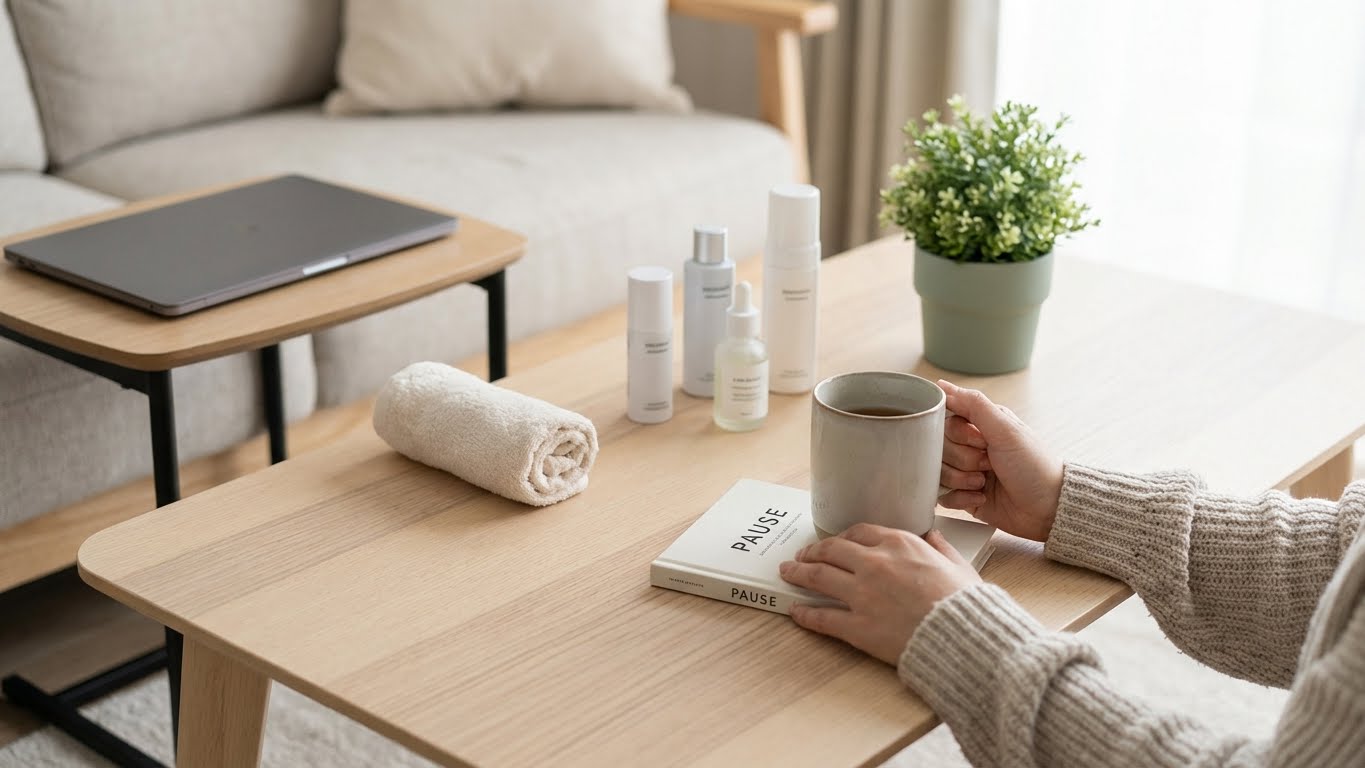
You finished your tasks early. The laptop is closed. And yet, you’re still sitting at your desk scrolling through emails you’ve already read, feeling vaguely guilty about not doing more. Sound familiar? Self-care for work-from-home days often gets tangled up with productivity guilt—the nagging sense that if you’re home, you should be accomplishing something. But here’s the thing: rest is not a reward you earn. It’s maintenance.
This post is about the other kind of self-care. Not the “optimize your morning routine” kind. Not the “batch your tasks” kind. We’re talking about the small, restorative moments that make working from home actually sustainable—without turning your entire life into a to-do list. You’ll walk away with simple rituals that take five minutes or less, ways to create real mental separation between work and rest, and permission to stop treating your home like a 24/7 office.
Quick Self-Care Wins for WFH Days
- Change out of your work clothes the moment you log off—even if “work clothes” is just a different hoodie.
- Step outside for two minutes between tasks. Not a walk. Just outside.
- Eat lunch somewhere other than your desk. The couch counts.
- Light a candle or open a window when you start your non-work hours.
- Put your phone in another room for 30 minutes. See what happens.
Why Work-from-Home Self-Care Feels So Hard

When your commute is twelve steps from your bed to your laptop, the lines between “on” and “off” blur fast. There’s no physical transition. No train ride to decompress. No walking through a door that signals the workday is over. Your brain doesn’t get the memo.
A common issue is that people treat flexibility like it means availability. Just because you can answer that Slack message at 7 PM doesn’t mean you should. And just because you’re home doesn’t mean you’re resting. Sitting in the same room where you just spent eight hours staring at spreadsheets isn’t exactly a spa retreat.
The mental load of remote work is sneaky. You might not be physically exhausted, but decision fatigue, screen time, and the low-grade stress of always being reachable add up. That’s why work-from-home self-care isn’t about bubble baths (though those are fine). It’s about creating boundaries your brain can actually recognize.
Small Rituals That Create Real Separation
You don’t need a home office with a door that locks to feel like you’ve left work. What you need are sensory cues—small signals that tell your nervous system the workday is done.
The “Fake Commute”
This sounds silly, but it works. When you finish work, leave your house. Walk around the block. Get a coffee. Sit on your front step for five minutes. Then come back inside. You’ve now “arrived home.” Your brain registers the shift in a way that simply closing your laptop doesn’t.
Change Your Environment
If you work in your living room, rearrange one thing when you’re done. Move a pillow. Turn off the overhead light and switch to a lamp. Fold up your laptop and put it out of sight. These tiny changes help your space feel different—less office, more home.
Sound and Scent Anchors
Play a specific playlist only during non-work hours. Light a candle you never burn while working. Over time, your brain starts associating these cues with relaxation. It’s not magic. It’s just conditioning, and it’s surprisingly effective.
Common Mistakes (and How to Avoid Them)
- Treating rest like a task. If your self-care routine has fifteen steps and a timer, it’s not rest—it’s another project. Keep it simple. One thing. Five minutes. Done.
- Waiting until you’re burned out. Self-care isn’t crisis management. A few minutes of intentional downtime every day beats a desperate spa weekend every six months.
- Staying in “work mode” clothes all day. Pajamas are fine for working. But changing into different pajamas after work? That’s a boundary. Your brain notices.
- Scrolling as a break. Switching from work screens to social media screens isn’t rest. Your eyes are still tired. Your brain is still processing. Try something that doesn’t involve a screen—even for ten minutes.
- Feeling guilty about doing nothing. Staring out the window is not a waste of time. Neither is sitting quietly with a cup of tea. Boredom is not a character flaw. It’s actually where a lot of good ideas come from.
Low-Effort Self-Care Ideas That Actually Help
Not everything has to be a whole ritual. Sometimes the best self-care is the thing you can do in under five minutes without planning, supplies, or motivation.
For Your Body
- Stretch your neck and shoulders for sixty seconds. That’s it.
- Drink a full glass of water before you reach for more coffee.
- Stand up and shake out your hands. Weird, but it helps.
- Take three slow breaths before you open your inbox in the morning.
For Your Mind

- Write down one thing that went okay today. Not great. Just okay.
- Text a friend something that isn’t about work.
- Look out a window for two minutes. No phone. Just looking.
- Say out loud: “I’m done for today.” Your brain likes hearing it.
For Your Space
- Clear your desk at the end of the day—even if “clear” just means stacking papers in a pile.
- Open a window for fresh air, even briefly.
- Put your work laptop somewhere you can’t see it from the couch.
If You Only Have Five Minutes
Let’s be realistic. Some days, you’re not going to have an hour for a bath or a long walk. You’re going to have five minutes between meetings, or five minutes before you collapse on the couch. Here’s what to do with them.
Option 1: Step outside. Don’t walk anywhere. Just stand there. Feel the air. Come back in.
Option 2: Make a hot drink and actually sit down to drink it. Not at your desk. Not while checking email. Just drinking.
Option 3: Lie flat on the floor. Seriously. It’s called “constructive rest,” and it resets your posture and your brain. Set a timer if you’re worried about falling asleep.
Option 4: Put on a song you love and do nothing else while it plays. Three minutes of actual listening—not background noise—can shift your mood more than you’d expect.
Frequently Asked Questions
Is it okay to do nothing on a work-from-home day?
Yes. Doing nothing is not the same as being lazy. Rest is part of how your brain processes information and recovers from focus. If you’ve done your work, you don’t owe anyone your free time.
How do I stop feeling guilty about taking breaks?

Start small. Take a five-minute break and notice that nothing falls apart. Repeat. Over time, you’ll build evidence that breaks don’t make you less productive—they make you more sustainable.
What if I live in a small space and can’t separate work from home?
Focus on time-based and sensory boundaries instead of physical ones. Use lighting changes, sound, scent, or clothing to signal transitions. Even putting your laptop in a drawer at the end of the day helps.
Does self-care have to cost money?
Not at all. Most of the best self-care is free: rest, fresh air, quiet, movement, connection. You don’t need products or subscriptions. You need permission to stop.
Summary and Next Step
Self-care for work-from-home days isn’t about adding more to your plate. It’s about protecting the space between work and everything else. Small rituals, sensory cues, and genuine rest—not optimized rest, not productive rest—are what make remote work sustainable long-term. You don’t have to earn your downtime. You just have to take it.
Pick one thing from this post. Just one. Try it today. Maybe it’s the fake commute. Maybe it’s lying on the floor for three minutes. Maybe it’s finally eating lunch somewhere other than your desk. Start there. See how it feels. That’s enough.