
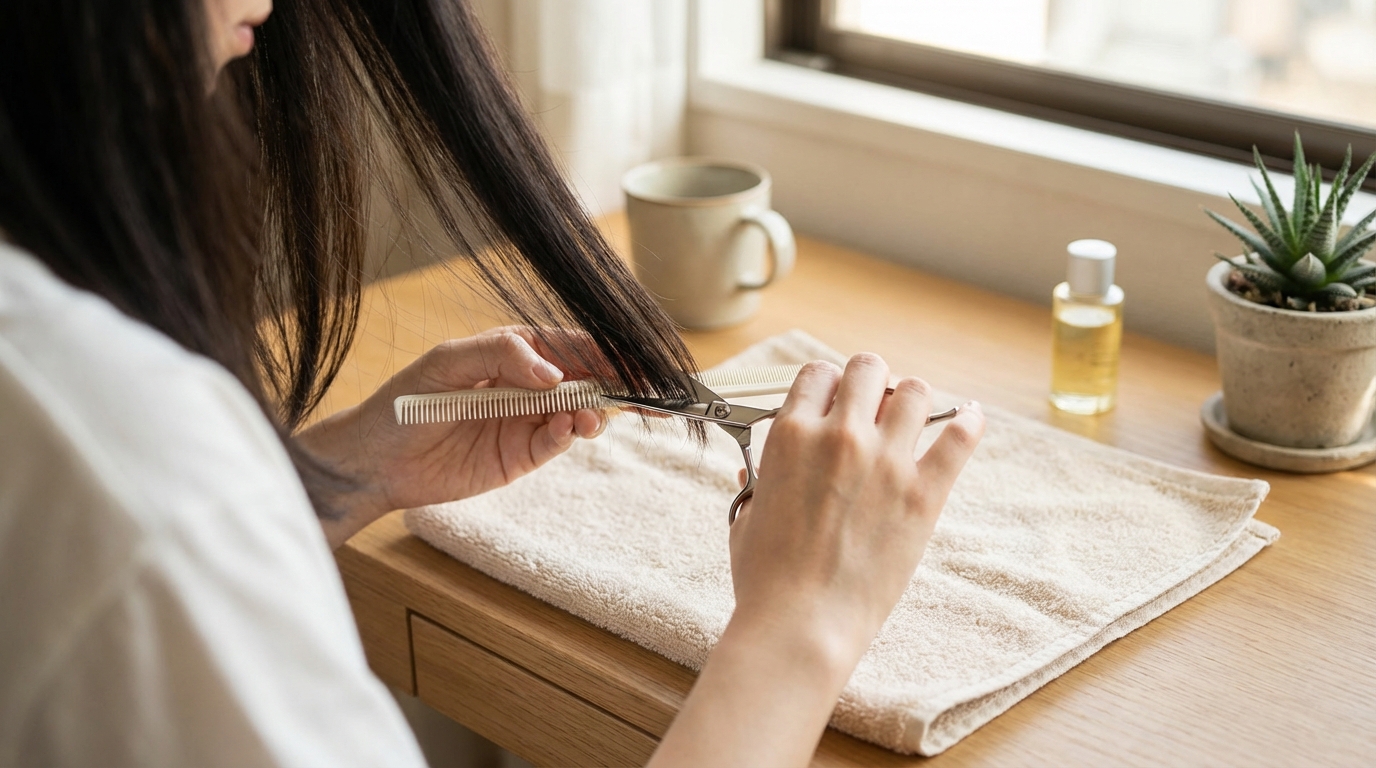
You’ve been staring at those wispy, see-through ends for weeks now. Maybe your next salon appointment is still a month away, or maybe you’re trying to stretch your budget a little further between cuts. Either way, learning how to trim your own ends at home can save you time, money, and that frustrating feeling of watching your hair look increasingly tired. The good news? You don’t need professional training to do a simple maintenance trim.
This guide walks you through the basics of trimming your ends safely, what tools actually matter, and how to avoid the mistakes that turn a quick refresh into a hair emergency. By the end, you’ll feel confident enough to snip away damage without losing length you wanted to keep.
Quick Steps for Trimming Your Ends
- Start with clean, dry hair (wet hair shrinks and leads to cutting too much)
- Use sharp hair scissors only—kitchen scissors will cause more split ends
- Work in small sections, cutting less than you think you need
- Cut at a slight angle rather than straight across for a softer look
- Check your work in natural light before calling it done
What You’ll Need
- Sharp hair-cutting scissors (not craft scissors, not kitchen scissors)
- A fine-tooth comb
- Hair clips or elastics to section your hair
- A handheld mirror (if you’re trimming the back)
- Good lighting—natural daylight works best
- A towel or cape to catch the clippings
A quick note on scissors: this is the one place worth spending a little money. Dull or multi-purpose scissors crush the hair shaft instead of cutting it cleanly, which actually creates more split ends than you started with. You can find decent hair scissors for a reasonable price, and they’ll last years if you only use them for hair.
How to Trim Your Own Ends Step by Step
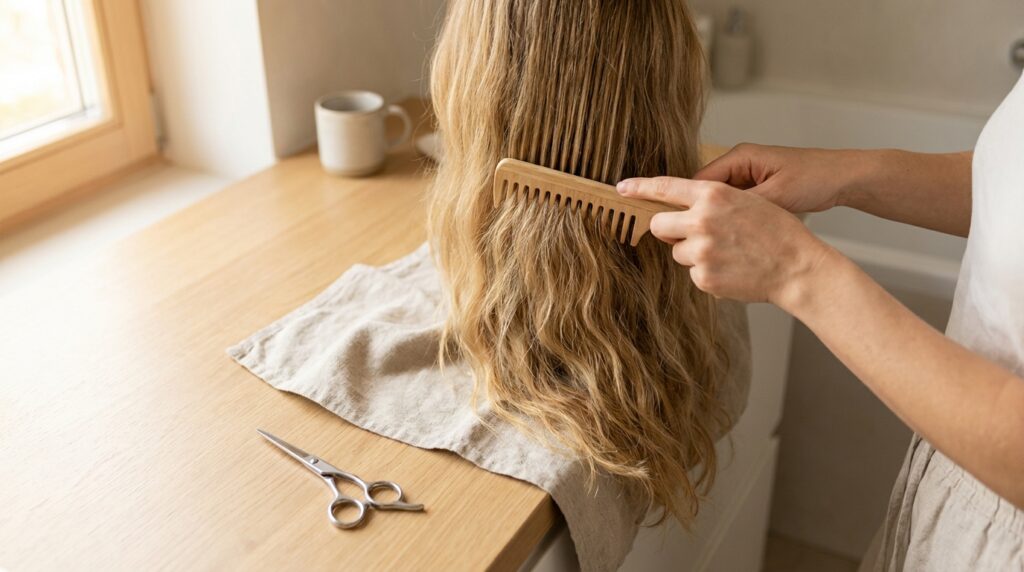
Step 1: Start with clean, completely dry hair. This part matters more than people realize. Wet hair stretches, so what looks like half an inch when wet might be a full inch once it dries. If you have wavy or curly hair, this difference is even more dramatic. Wash your hair, let it dry naturally or blow it out, and then begin.
Step 2: Brush or comb through your hair to remove any tangles. You want to see exactly what you’re working with. If your hair is curly, finger-detangle gently instead of brushing it straight—you’ll want to trim it in its natural state so the length stays even when it curls back up.
Step 3: Section your hair into manageable parts. For most people, dividing hair into four sections works well: two in front and two in back. Clip the sections you’re not working on out of the way. Trying to trim all your hair at once is how uneven cuts happen.
Step 4: Take a small subsection (about an inch wide) and comb it smooth. Hold the hair between your index and middle fingers, sliding down to where you want to cut. Here’s the key: cut less than you think you need. You can always take more off, but you can’t glue it back on.
Step 5: Cut at a slight upward angle rather than straight across. This technique, sometimes called point cutting, removes bulk and creates softer ends that blend naturally. If you cut perfectly horizontal, you might end up with a blunt line that looks choppy, especially on fine hair.
Step 6: Use your first section as a guide for the rest. Hold a piece of the already-trimmed hair next to the new section so you can match the length. Work your way around your head, section by section, checking as you go.
Step 7: Once you’ve trimmed all sections, let your hair fall naturally and check for evenness. Look in a mirror with good lighting—preferably near a window. If you spot any longer pieces, carefully snip them to match. Resist the urge to keep “fixing” things, though. Perfectionism is how a trim turns into a full haircut.
Shortcut If You’re Short on Time
- Focus only on the front sections that frame your face—these are the most visible
- Skip sectioning and just trim the very bottom inch of your hair in a low ponytail (this works for one-length hair only)
- Do a “search and destroy” mission: twist small sections and snip only the split ends that poke out
- Trim dry, unstyled hair right before your next wash so you can shampoo away the tiny clippings
Common Mistakes When Trimming Your Own Ends
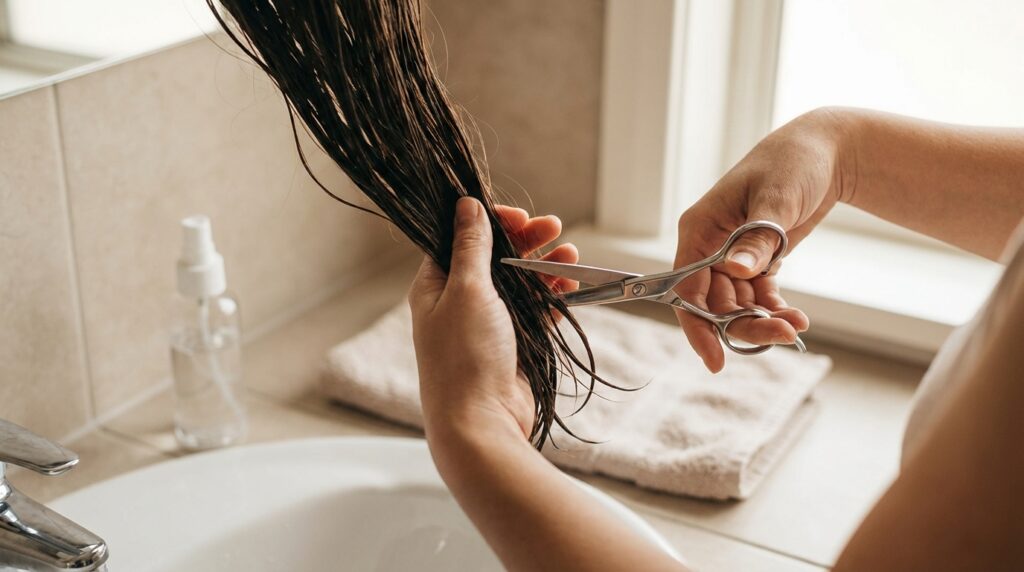
- Cutting wet hair: Unless you’re a trained stylist who knows how to account for shrinkage, dry trimming is safer for home cuts.
- Using dull or wrong scissors: Paper scissors, kitchen shears, and craft scissors all damage hair. Invest in one pair of actual hair scissors.
- Taking off too much at once: Start with a quarter inch. You can always do another pass if you want more off.
- Cutting straight across on curly hair: Curly hair needs to be trimmed curl by curl in its natural state, or you’ll end up with uneven lengths when it springs back.
- Trimming in bad lighting: Dim bathroom lighting hides unevenness. Move near a window or use a bright lamp.
- Over-correcting: If one side looks slightly shorter, resist the urge to keep evening it out. This is how a trim becomes three inches shorter than planned.
How Often Should You Trim Your Ends?
The old advice of trimming every six weeks isn’t a universal rule—it depends on your hair type, how much heat styling you do, and how fast your hair grows. If you’re trying to grow your hair out, trimming every ten to twelve weeks is usually enough to keep ends healthy without sacrificing length.
If you notice your ends looking thin, tangled, or splitting visibly, that’s your cue. Some people can go months between trims; others need more frequent maintenance. Pay attention to how your hair feels and looks rather than following a strict calendar.
When to Skip the DIY and See a Professional
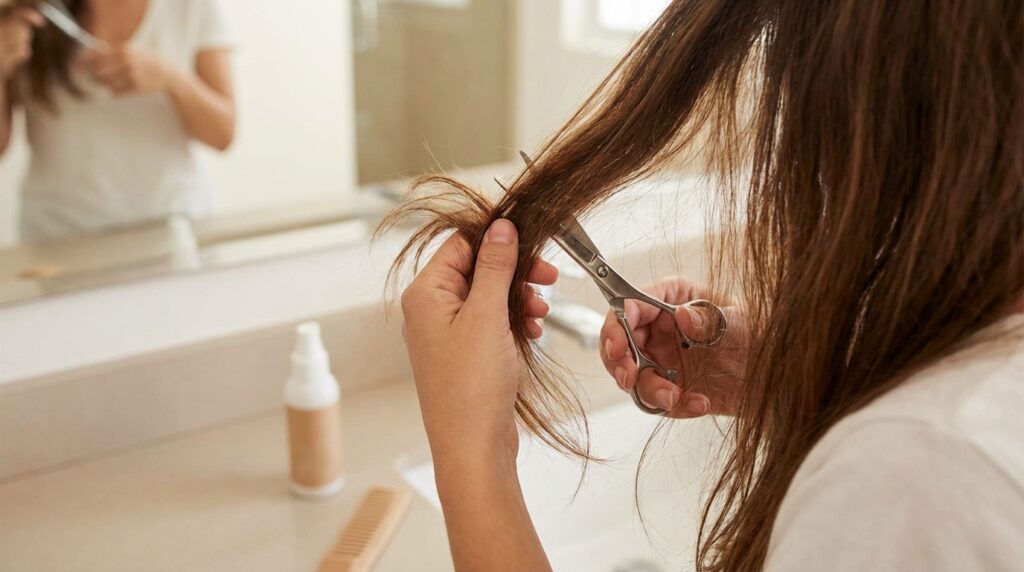
Home trims work great for maintenance—removing a small amount of damage between salon visits or keeping your ends fresh when budget is tight. But there are times when it’s worth booking an appointment instead.
If you want to change your style, add layers, cut bangs, or take off more than an inch or two, a professional will get better results. The same goes if you’ve had a color treatment that’s left your hair in rough shape—a stylist can assess the damage and cut strategically. Think of home trimming as upkeep, not transformation.
Frequently Asked Questions
Can I trim my ends with regular scissors?
Technically you can, but it’s not recommended. Regular scissors aren’t sharp enough to make a clean cut, so they crush and fray the hair shaft. This leads to more split ends forming quickly. Hair scissors are sharper and designed to slice cleanly through hair.
Should I trim my hair wet or dry?
For most home trims, dry is safer. Wet hair stretches and appears longer than it actually is, so you might cut off more than intended. Professionals often cut wet hair because they’re trained to account for shrinkage, but if you’re new to this, stick with dry.
How much should I cut off?
For a basic maintenance trim, a quarter inch to half an inch is usually enough to remove damaged ends without losing noticeable length. If your ends are severely split or see-through, you might need closer to an inch—but start small and assess before cutting more.
Will trimming my ends make my hair grow faster?
Trimming doesn’t speed up growth since hair grows from the scalp, not the ends. However, regular trims prevent split ends from traveling up the hair shaft and causing breakage. So while your hair won’t grow faster, you’ll retain more length because less is breaking off.
Summary and Next Step
Trimming your own ends at home is a practical skill that saves money and keeps your hair looking healthier between salon visits. The essentials are simple: use proper scissors, work with dry hair, cut less than you think you need, and check your work in good lighting. Avoid the temptation to keep “fixing” small imperfections—that’s where DIY trims go wrong.
Your next step? If you don’t already own a pair of hair scissors, that’s your starting point. Once you have the right tool, try a small trim on just the front sections of your hair to build confidence before tackling the whole head. A little practice goes a long way, and your ends will thank you.