
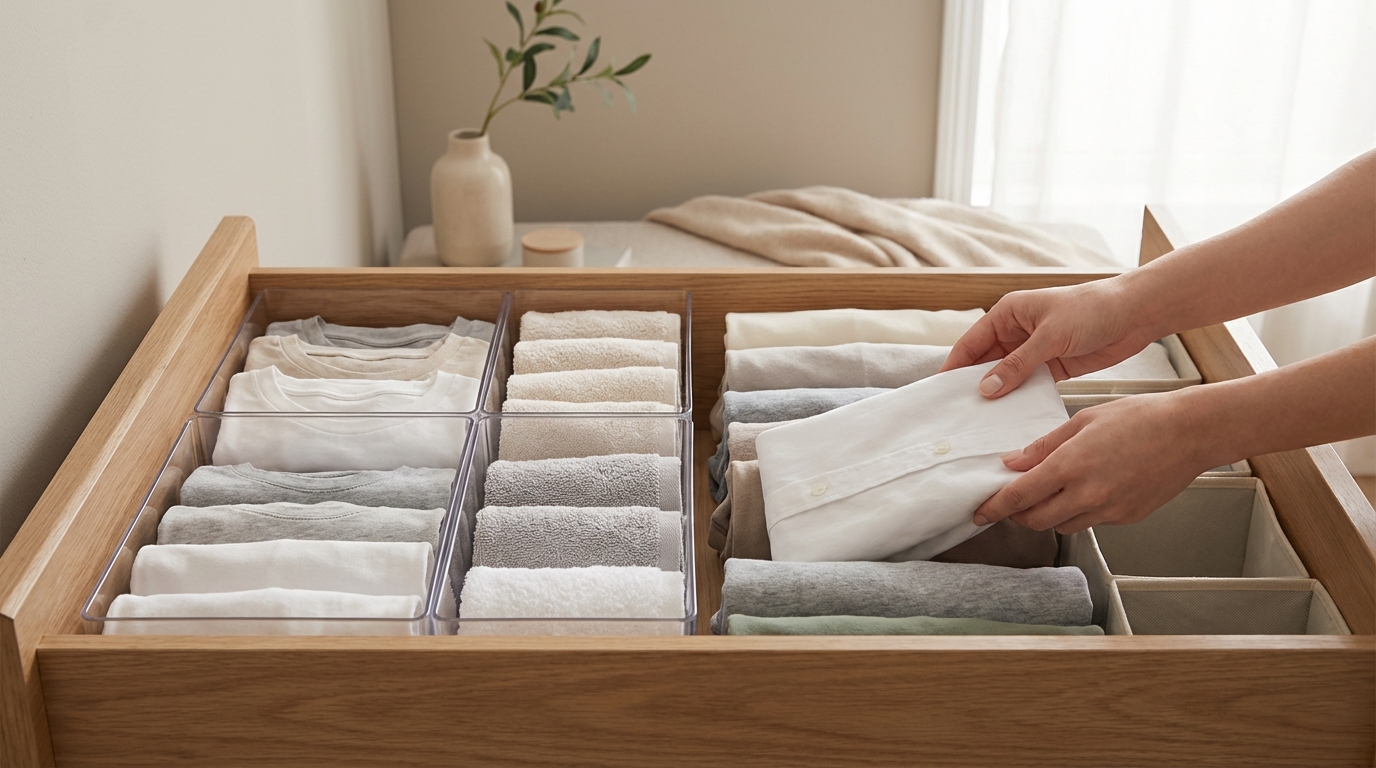
You open your dresser to grab a t-shirt, and somehow the entire drawer looks like it survived a small tornado. Sound familiar? The debate around drawer dividers vs. folding methods comes down to one question: what actually keeps your clothes visible, accessible, and not crumpled into sad little balls?
Quick Verdict: Neither method is universally “better.” Drawer dividers work best for small items and shared spaces where boundaries matter. Folding methods (like the KonMari file fold) shine for maximizing visibility and fitting more into tight drawers. For most people, combining both delivers the best results—but if you’re picking just one, your drawer depth and what you’re storing should decide.
What Each Approach Actually Does
Before picking sides, it helps to understand what problem each method solves.
Drawer dividers create physical barriers inside your drawer. They section off space so socks don’t migrate into underwear territory, and your workout gear stays separate from your pajamas. Dividers range from simple cardboard inserts to adjustable bamboo grids and fabric bins.
Folding methods focus on how you shape and arrange each item. The goal is usually to fold clothes into compact rectangles that stand upright (file folding) rather than stacking flat. This lets you see everything at a glance instead of digging through layers.
Here’s the key difference: dividers organize space, while folding methods organize items. One controls where things go; the other controls how much fits and how visible it stays.
Drawer Dividers: Pros and Cons
Pros
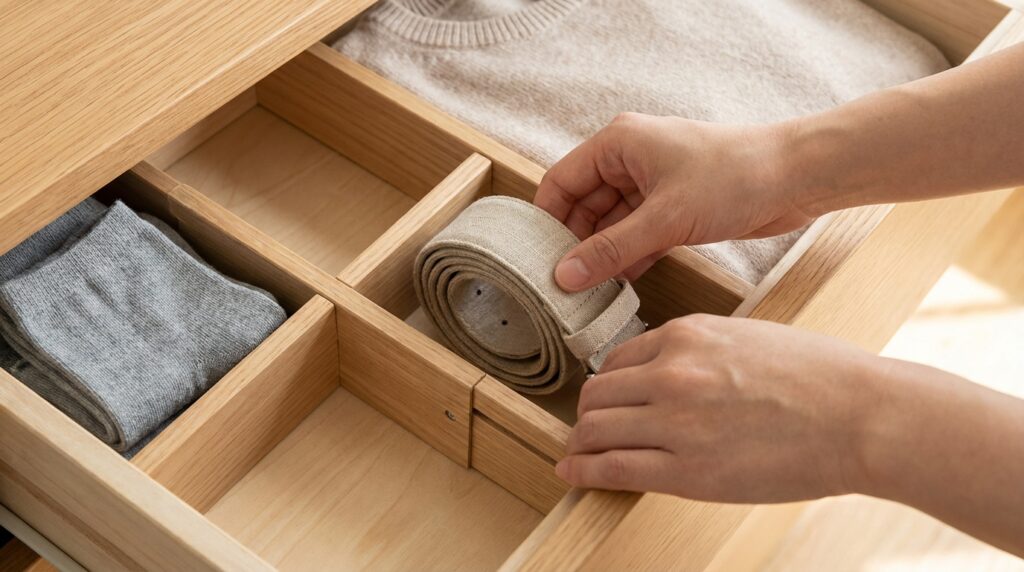
- Instant boundaries: No more sock avalanches into your underwear section. Each category gets its own zone.
- Great for small items: Belts, ties, jewelry, and accessories stay put instead of sliding around.
- Low maintenance: Once installed, dividers do the work. You don’t need to fold perfectly—just toss items into the right compartment.
- Helpful for shared drawers: If two people share a dresser, dividers create clear “yours” and “mine” zones without negotiation.
- Works with any folding style: Even if you’re a “roll and stuff” person, dividers keep chaos contained.
Cons
- Reduces usable space: The dividers themselves take up room. In shallow drawers, this can cost you 10-15% of your storage capacity.
- Fixed sizing issues: Many dividers come in standard sizes that don’t match your drawer dimensions. Adjustable options cost more ($15-30 vs. $5-10 for basic inserts).
- Doesn’t solve visibility: If you stack items flat inside each compartment, you still can’t see what’s at the bottom.
- Can encourage overstuffing: “It fits in the box” becomes the only rule, leading to crammed compartments.
Best for: Accessories, undergarments, shared spaces, and anyone who wants a “drop and go” system without precise folding.
Skip this if: Your drawers are shallow (under 4 inches deep), you’re storing bulky items like sweaters, or you want to maximize every inch of space.
Folding Methods: Pros and Cons
Pros
- See everything at once: File folding (standing items upright) means no more forgotten shirts buried at the bottom.
- Maximizes capacity: Proper folding can fit 20-30% more items in the same drawer compared to flat stacking.
- Zero cost: You don’t need to buy anything. Just learn the technique.
- Works for all drawer sizes: Shallow, deep, wide, narrow—folding adapts to any space.
- Reduces wrinkles: Compact folds with smooth edges keep clothes neater than crumpled piles.
Cons
- Requires consistency: The system only works if you fold items the same way every time. One lazy laundry day can undo the whole drawer.
- Learning curve: File folding takes practice. Expect 2-3 weeks before it feels automatic.
- Doesn’t contain small items: Socks and underwear can still shift around without physical barriers.
- Time investment upfront: Re-folding an entire drawer takes 15-30 minutes initially.
Best for: T-shirts, pants, pajamas, workout clothes, and anyone who wants to see their full wardrobe without digging.
Skip this if: You genuinely hate folding, share drawers with someone who won’t maintain the system, or you’re organizing tiny items like jewelry.
The Real Deciding Factors
Forget the Instagram-perfect drawer photos. Here’s what actually matters when choosing between drawer organizers and folding techniques:
Drawer depth: Shallow drawers (under 4 inches) benefit more from folding because dividers eat into limited vertical space. Deep drawers can handle both.
What you’re storing:
- Small, loose items (socks, underwear, accessories) → Dividers win
- Clothing you wear daily (t-shirts, pants) → Folding wins
- Bulky items (sweaters, hoodies) → Neither—these belong on shelves or in deeper bins
Your patience level: Be honest. If you already skip folding and shove clean laundry into drawers, dividers will at least keep the chaos organized. A folding system you won’t maintain is worse than no system at all.
Counter-intuitive insight: Perfectly organized drawers can actually slow you down. If you spend 30 seconds refolding a shirt every time you put laundry away, that’s 3+ hours per year on drawer maintenance. Sometimes “good enough” beats “perfect.”
Combining Both Methods
Here’s what actually works for most wardrobes: use dividers for categories, and folding for visibility within each section.
Example setup for a standard dresser drawer:
- Install adjustable dividers to create 2-3 sections (e.g., workout clothes | casual tees | sleep shirts).
- Within each section, file-fold items so they stand upright.
- Leave a small “landing zone” at the front for items you’re too tired to fold properly—this prevents one messy item from destroying the whole system.
Smart Tip: Before buying dividers, measure your drawer interior (length, width, depth) and check product dimensions. Many “universal” dividers are designed for standard 15-inch wide drawers—if yours are narrower or wider, you’ll end up with gaps or items that don’t fit.
This hybrid approach costs around $10-20 for basic adjustable dividers and takes about 30 minutes to set up per drawer. Most people report it stays organized for 2-3 months before needing a quick reset.
Quick Decision Guide
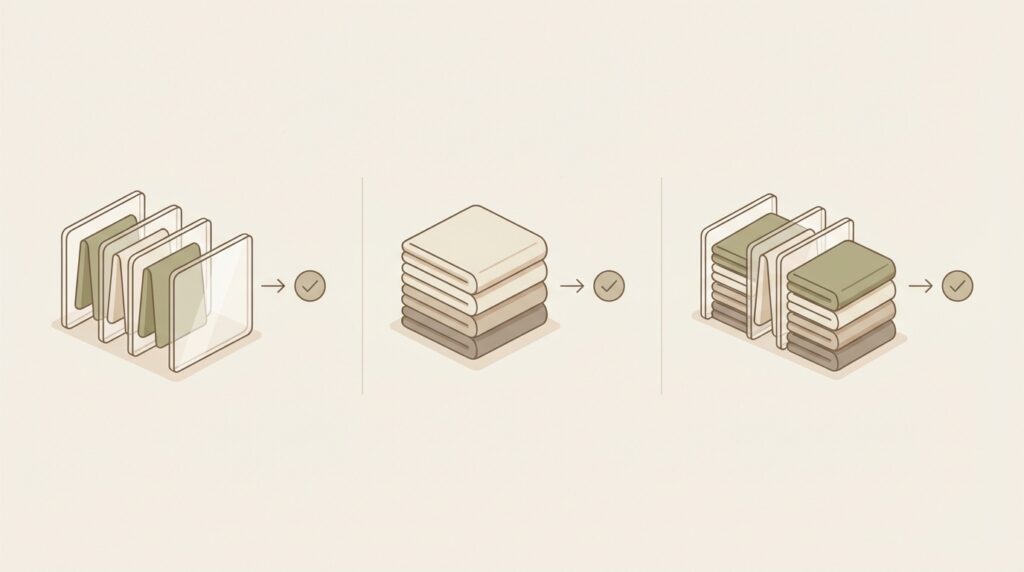
Still unsure? Use this:
- Choose dividers alone if: You organize accessories, share drawer space, or want a low-effort system that tolerates imperfect folding.
- Choose folding alone if: You have shallow drawers, store mostly clothing (not accessories), and don’t mind the 2-week learning curve.
- Combine both if: You have standard-depth drawers, store a mix of clothing and small items, and want maximum visibility with clear category boundaries.
Frequently Asked Questions
Do drawer dividers damage drawers?
Most don’t. Bamboo and plastic dividers with rubber grips are safe for wood finishes. Avoid spring-loaded tension dividers in antique or soft-wood drawers—they can leave pressure marks over time.
How long does it take to learn file folding?
About 2-3 weeks of consistent practice. The first few times feel slow (1-2 minutes per shirt), but it drops to 10-15 seconds once muscle memory kicks in.
Can I use shoeboxes as dividers?
Yes, and it’s a solid budget hack. Cut shoeboxes to your drawer height and line them up. They work well for socks, underwear, and accessories. Replace them every 6-12 months as they soften.
What’s the best divider material?
Bamboo is durable and looks nice but costs more ($15-25). Plastic is budget-friendly ($8-15) and easy to clean. Fabric bins work for soft items but can sag over time.
The Bottom Line
Drawer dividers and folding methods solve different problems. Dividers create structure; folding creates visibility. For most people, using both together—dividers for boundaries, file folding for access—delivers the tidiest results with the least daily effort.
Start with one drawer. Measure it, decide what you’re storing, and pick the approach that matches your actual habits (not your aspirational ones). A simple system you’ll actually use beats a complex one you’ll abandon in two weeks.